Saturday, April 16, 2011

Unexpected arrival

We made pizza last night. And it was good. Really good. Really, really good. I think we've finally figured out how to make good pizza.

From Really Good Pizza


The crust was thin but chewy, with lots of air bubbles and a definite structure; but it was soft and bready, not pastry-like.

From Really Good Pizza


The crust is certainly the single most important factor to good pizza. We started out making the dough he night before, refrigerating it immediately, and letting it rise just before using it. That worked very well, but we thought we could do better. We've tried several different things to make it better, but we've really only been able to improve a single aspect of the crust at a time; at the cost of others.

This time we made the crust the night before, let it rise and punched it down a few times overnight, and portioned it into crust-size dough balls the next day, which we refrigerated until an hour or so before we used them.

I've been told the secret to good bread is to let it rise many times. All my experiments appear to confirm this statement. Certainly this last batch of pizzas seems to do so.

From Really Good Pizza


So I guess we can stop making pizza now. We appear to be at the top of our game.

Friday, April 15, 2011

Smoky Friday

I've actually accrued enough vacation time that I stopped accruing: I have to take some time off. So I had a chat with my boss and I took off yesterday and today.


So I got up early this morning and put a couple pig shoulders and a pork roast on the grill. 200 F, baby! It's been on there just over 9 hours now, and coming nicely.

I love me some BBQ.

We (re)watched Alton Brown's Feasting on Asphalt a few weeks back, and I noticed his comments on BBQ: you can't fake it, you can't hurry it up, you can't mass-produce it. With some minor caveats he's right. Barbecue is one of the simplest foods I know how to make; but it's one of the hardest to find made right. It's baffling to me the efforts people will make to produce decent Q when the genuine article is so simple. People will hunt for specialty woods, use exotic spice combinations, and buy all manner of complicated cookers (have you priced a Pitts & Spitts?) to produce what was traditionally cooked over an open pit in the ground with whatever wood was available.

So here's how to make authentic barbecue:

  1. Choose a tough cut of meat, anything suitably low-grade will do. I prefer pig shoulders, but beef brisket, spare ribs, and whole poultry work well. I generally buy the cheapest pork I can find, which is usually the shoulder. The whole point of BBQ is to make something delectable from an inedibly tough cut of meat.

  2. Cook over charcoal. Barbecue is cooked in wood smoke: charcoal is wood that's been burned in an oxygen-deprived environment to drive off moisture, phenols, and various other impurities. You can just cook over wood, of course, but you need to burn it down. Raw wood isn't fit for cooking over. Of course you might like to throw some bits of wood into your fire to add some interesting smoke, but don't do that too much: creosote doesn't taste good.

  3. Keep a steady temperature. Barbecue is really all about rendering fat and tough connective tissues in the meat. If you hit the meat with a temperature that's too high you'll toughen it up, dry it out, and turn those tissues into knots. The ideal BBQ temperature is 200F, but I generally don't worry too much as long as my grill's between 190F and 250F. Temperatures spike up and down, but you want them to average in the low 200s.

  4. Take lots of time. Barbecue takes a lot of time to cook; enjoy the downtime. I budget between 12 and 20 hours for a BBQ session.

  5. Baste with mild flavours. I baste with a North Carolina-style baste made from apple cider vinegar, water, and spices. It's thin and vinegary, which offsets the high-fat pork. Sauces high in sugar or tomatoes can caramelize on the grill, so they really only should be used at the very end of the cook. I've had a lot of excellent Q that was cooked completely dry, but I like to baste a little now and then. It seems to make the "bark" a little more interesting.

  6. Cook to a high internal temperature. The whole point of BBQ is to cook slowly so that the meat can actually get to a higher temperature. It's a lot like braising, but without moisture. The higher temperature is what gives the Q its beautifully soft and moist texture.


Ultimately it's easier to make good BBQ properly than it is to fake it. It's not about the wine barrel staves used for fuel or the rare pomegranate juice you put into your sauce. It's about watching your temperature and taking your time.

Which isn't to say I don't want a Pitts & Spitts, or that I don't like to try varying things now and then on my grill. And honestly, I've had excellent BBQ cooked too hot on a propane grill. But when it comes down to it, BBQ is all about the simple joys.

Monday, January 31, 2011

True craftsman

I just love this film. It runs about an hour, and it's well worth the time to watch it.

Watching this guy is simply stunning: he is clearly master both of his tools and his medium. Whether it's the axe or the paddle, he's right at home.

Saturday, January 22, 2011

I only wanted a cheesbuhguh!

I'm not a big fan of that quintessential American food, the burger. I'd rather have a dog with chili and jalapenos any day. But the love of my life esteems burgers roughly equivalently to how I think of pizza, so I've been trying to learn to make the perfect burger.

I started with Alton Brown's Burger of the Gods recipe, which is basically just ground meat, salt, and pepper. The advice about being careful not to over-work the meat is sound: I've learned the hard way that burgers are best when the meat is only "lightly tossed" with the salt and pepper.

From Cheeseburger


We've been cooking them on a griddle, with a flatten on the flip. I form the meat into balls and throw them on the griddle. When they're browned on the bottom, they get flipped and pressed flat with the spatula to form a patty.
From Cheeseburger


Flattening them takes some practice. I'm not an expert yet, but I've been working on it...
From Cheeseburger


From Cheeseburger


Of course cheese is necessary for a cheeseburger.
From Cheeseburger


It needs to be added on the griddle so it melts properly.
From Cheeseburger


It can overcook pretty easily, so I keep an eye on it as it cooks.
From Cheeseburger


Then off to the bun.
From Cheeseburger


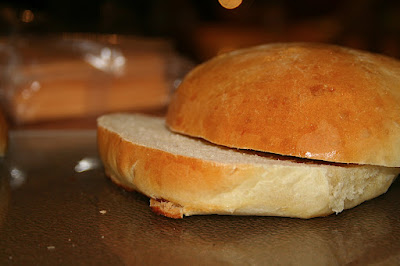
But I've been having trouble with getting a good hamburger bun. Last week I tried a Kaiser roll recipe I found, but they weren't quite the ticket. Don't get me wrong: the recipe worked reasonably well. But the rolls weren't quite what I was looking for. So today I tried the perfect burger bun recipe on Annie's Eats. This might be the one I've been looking for.
From Cheeseburger


I'm the first to admit that Annie's look better than mine, but these are at least respectable.
From Cheeseburger


Annie's recipe calls for bread flour: I just used the same unbleached all-purpose flour I use for everything else. I let the dough rise twice before shaping it, to try and get a little more yeast action. I figured that might make up for my flour choices.
From Cheeseburger


From Cheeseburger


This might well be the bun recipe I was hoping to find. I have to say, the finished product was good.
From Cheeseburger


And ultimately, it got the results I've been hoping for.
From Cheeseburger

Tuesday, December 7, 2010

In every pot

I've been cooking a lot of chook recently. I'm afraid the family's getting a little tired of chicken stew, but it's just not getting old for me.

From Chicken stew


Looks like we've finally figured out how to make a good chicken stew. I have to confess that I made mediocre chicken stews for years, coasting on the fact that it's hard to really ruin chicken...

So here's how we do it:

First I take down my favourite stew pot: my 5-Quart cast iron Dutch oven by Lodge Logic. I chop up a large onion (or two medium onions, or...) and a few of those "baby carrots" and a couple sticks of celery. I put a healthy thwack of butter into the pan and get it hot. Onions, carrots, and celery go into the butter along with a couple garlic cloves. They get covered in a generous dose of salt and way too much black pepper, then I cook them until the onions are translucent. Once done, I empty the pot into a bowl.

From Chicken stew


Next I brown the chicken. I generally take some leftover bacon grease and add it to the pot, which is already hot. I put in more than enough to cover the bottom: there was a good 1/8 inch of grease in there this last time. I put three or four chicken thighs (skin on) into the grease, put salt and a generous layer of pepper on them, and let them brown. Now here's the thing: when I say "brown", I mean "mahogany". I essentially fry those thighs in that bacon grease for twenty or more minutes. When one side gets brown, I turn them over and do the other side. If I want to use more chicken I brown it in batches of three or four so they all get plenty of one-on-one time with the cast iron and bacon grease.

From Chicken stew


Once the chicken is brown, I put the onions, carrots, and celery back in the pot, cover it, and cook at medium for a good 45 minutes or so.

As the chicken is stewing in the onions, I cut some red potatoes, wash them, and pan-fry them. So I put some bacon grease on the griddle and lay out the potato chunks in it to fry. When one side is brown, I roll them to brown the other. I want the potatoes to have a healthy golden-brown crust.

Once the potatoes are done it's time to pull the skin off the chicken. Chicken skin is high in fat, so you really don't want to eat it.

Then the potatoes go into the pot along with frozen green beans, I cover it, and cook at until it's all done. I like to cook this at a medium on the stove-top, or 250--300F in the oven.

From Chicken stew


Be aware this is not low-fat cooking. It's highly likely you'll have a massive coronary while eating my cooking. But my goodness it's good.

Sunday, December 5, 2010

Wow

I, uh, haven't had a lot to say. More probably I've been too busy to say it.

Friday, July 23, 2010

Every minute

I had a problem with my jaw this week. I woke up Tuesday and it felt out of joint. It hurt Tuesday and Wednesday, and Thursday I was starting to wonder if there was a serious problem. So I made an appointment to go to the Chiropractor and have him pop it back in. This morning I woke up feeling great. But because I had an appointment, I figured I might as well go in.

So I went to the chiropractor with no real complaints, but feeling a sense of obligation because I'd made an appointment.

After 2 1/2 hours, I'm $270 lighter and they want me to come back Tuesday. And bear in mind the reason I went in the first place was a jaw problem that cleared itself up. So it cost me 2 1/2 hours and $270 to feel coming out exactly like I did going in.

And they want me to come back Tuesday for another $60 session. Apparently I have all sorts of spinal alignment issues.

Uh-huh.

I just called them back and canceled my follow-up without a reschedule. They say there's one born every minute, but this time his name's not going to be Ox.