Well, it's been almost exactly one year since I finished reading my ESV on January 28, 2007. Well, I just finished the next step in my Bible Quest: it's January 25, 2008 and I just finished reading my NASB. I wanted to read it through in one year, and it looks like I did.
If you don't remember my Bible Quest, I've been picking a bunch of Bible translations and reading each cover-to-cover. I'm aiming at one per year, which works out to 3 or 4 chapters a day. Of course, my sporadic reading makes it more like 10 or 15 chapters in one sitting, then realizing a couple days later I need to read some more. Of course I don't always read on a schedule: I frequently depart the schedule for a couple days to read something out of sequence... but the idea is to read cover-to-cover, Genesis to Revelation, roughly in order.
The first in my quest was the ESV. I wrote a review of it last year, but I've found it's really good for "just reading," better than the NASB by a long shot.
NASB is reputed to be a "wooden" translation: too literal to be easy to read. While I whole-heartedly agree that the ESV is much better to sit and read, I didn't find the NASB to be obtuse. Far from it, I found it a little too familiar in places---almost condescending in its effort to write simple English. Of course, this is the "new" NASB, the 1995 version. By all accounts it's easier to read than the previous version. Perhaps that explains it.
I'd love to try a new translation this year, but I suspect I'll have to wait six months or so before I can feasibly do that. In the meantime, I think I'll break in my new Darby Translation (my 1973 Stow Hill #25) by giving it a cover-to-cover.
I have to say, I find Darby's my favourite and most-used translation. I switched to Darby in 1992, and used it almost exclusively until 2007 when I bought the ESV. Yeah, I have a few KJV Bibles I occasionally read, but Darby was my main translation for 15 years, and for most of that time it was the only one I actually read: KJV has always been my memorizing Bible.
So I'm planning to start Genesis 1:1 tomorrow in my "new" Darby and see how it goes. Perhaps reading ESV and NASB have spoiled Darby for me; I doubt it.
As far as the next translation, I haven't decided what it should be. I feel like maybe I should read KJV cover-to-cover again. I've also never owned or used a NKJV: that might be worth a read. I've also been considering the Holman CSV and the old RSV (not the NRSV). Both of those have gotten some good reviews.
Showing posts with label bibles. Show all posts
Showing posts with label bibles. Show all posts
Friday, January 25, 2008


Friday, May 25, 2007
Bible Bag
I finally got a new Bible bag. Or Bible case, if you will. This fills a void long felt in my heart.
A few years ago, I desparately wanted a Brethren Bible Satchel. Well, that's probably not how they were marketed, but if you've spent any time at all around "brethren", you've seen them: the leather satchels just big enough to fit a huge Thumper Special. They've got a handle on the enormous top flap, and are divided into several compartments. Usually they contain a Bible or two, a hymn book, and various sundries. I wanted one of those so badly, but they cost in the neighbourhood of $70 and I couldn't afford one.
Since then, I've gone au naturel, carrying Bible and hymnbook in a casual stack; we used one of those tree-hugger shopping bags for a while; and I carried my old briefcase, which I first got as a gift from my parents when I started teaching high school.
They all had weak points: the stack has a tendency to scatter badly, and you can lose things easily. The shopping bag has no shape, so your books can get bent into all sorts of unnatural shapes; further, it's too big, so too much gets jammed in there, and it results in badly dog-eared books. The briefcase was the best of the lot, but with no real compartments, the books all bang around in there, and eventually I lost a lot of gilt from the pages of a new Bible.
I had considered getting one of the Brethren Bible Satchels, but they're apparently unavailable. All the traditional places to buy one no longer cary them, and searching the web gives no hints at all. I guess I missed my chance.
Well, a month or so ago, I found a new contender. I was in the Family Christian Store, looking for a Penfold Newberry Bible. They didn't have one, of course, but I thought I'd look anyway. I didn't buy the bag right away, but after a week or two of looking on the web and mulling it over, I bought this bag:
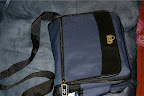
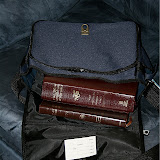
This bag is big enough to hold two Bibles, a hymn book, and various other things; but the compartments are small enough that the Bibles don't move around a lot. So it seems to fit the bill. Here it is with my NASB, my Darby, and my hymnbook:
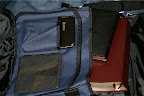
I can actually fit both my NASB and my KJV/Darby parallel in there, but I prefer the smaller Darby. Note too, that NASB is huge: it's a single-column edition, which means it's pretty thick.
For those who recall my love/hate relationship with ESV; here it is, posing with both my NASB and my ESV:

One downside is, for some reason they seem to think a Bible case is incomplete without CD holders. ??????? At any rate, I'll cut them out once I'm sure I can't find another use for them.
The only real problem is, it has a shoulder strap and no smaller handle. That means I can only carry it like a purse. Not a huge deal, but a smaller handle would be nice. I'll see if Ames can either make me one, or guide me in making my own.
A few years ago, I desparately wanted a Brethren Bible Satchel. Well, that's probably not how they were marketed, but if you've spent any time at all around "brethren", you've seen them: the leather satchels just big enough to fit a huge Thumper Special. They've got a handle on the enormous top flap, and are divided into several compartments. Usually they contain a Bible or two, a hymn book, and various sundries. I wanted one of those so badly, but they cost in the neighbourhood of $70 and I couldn't afford one.
Since then, I've gone au naturel, carrying Bible and hymnbook in a casual stack; we used one of those tree-hugger shopping bags for a while; and I carried my old briefcase, which I first got as a gift from my parents when I started teaching high school.
They all had weak points: the stack has a tendency to scatter badly, and you can lose things easily. The shopping bag has no shape, so your books can get bent into all sorts of unnatural shapes; further, it's too big, so too much gets jammed in there, and it results in badly dog-eared books. The briefcase was the best of the lot, but with no real compartments, the books all bang around in there, and eventually I lost a lot of gilt from the pages of a new Bible.
I had considered getting one of the Brethren Bible Satchels, but they're apparently unavailable. All the traditional places to buy one no longer cary them, and searching the web gives no hints at all. I guess I missed my chance.
Well, a month or so ago, I found a new contender. I was in the Family Christian Store, looking for a Penfold Newberry Bible. They didn't have one, of course, but I thought I'd look anyway. I didn't buy the bag right away, but after a week or two of looking on the web and mulling it over, I bought this bag:
This bag is big enough to hold two Bibles, a hymn book, and various other things; but the compartments are small enough that the Bibles don't move around a lot. So it seems to fit the bill. Here it is with my NASB, my Darby, and my hymnbook:
I can actually fit both my NASB and my KJV/Darby parallel in there, but I prefer the smaller Darby. Note too, that NASB is huge: it's a single-column edition, which means it's pretty thick.
For those who recall my love/hate relationship with ESV; here it is, posing with both my NASB and my ESV:
One downside is, for some reason they seem to think a Bible case is incomplete without CD holders. ??????? At any rate, I'll cut them out once I'm sure I can't find another use for them.
The only real problem is, it has a shoulder strap and no smaller handle. That means I can only carry it like a purse. Not a huge deal, but a smaller handle would be nice. I'll see if Ames can either make me one, or guide me in making my own.
 |
| Bible Bag |
Monday, January 29, 2007
Finally done!
I couldn't sleep last night, so I got up and read Philippians through Revelation in my ESV. My Great ESV Read is now over. It was a nice feeling to put my ESV on the shelf in a more permanent place: I've been keeping it on the top of my stack of Bibles, so it was the first one I'd grab.
I enjoyed the ESV. It was really a very enjoyable translation to read; but in the end, I found it too quirky a translation for serious study, so I shelved it.
I bought the Bible on June 26, 2006 and I finished it on January 28, 2007. I didn't start on Genesis 1:1 right away, but for the sake of argument, that's almost exactly seven months to read through it. Just for comparison, a lot of people work hard at reading their Bible through once a year, but Geo. Mueller is said to have read his through four times a year! That's roughly twice as fast as I read this Bible, and I felt like I was almost going too fast. My reading isn't very consistent, though. I will often read several books in one day, and nothing the next. I need to work on my consistency more.
This morning I started reading through my new (although second-hand) NASB. This is a pretty serious Bible: single-column, wide margins, minimal notes, lots of room to write.
I've read a lot of press about single-column Bibles, and so far, I think it's everything it's cracked up to be. But then, I'm only in Genesis 2. We'll have to see how that goes. One thing about single-column is, it makes the Bible a lot thicker: you can only get so many characters on a single line; that's why "we" started printing in multiple columns to begin with.
We'll see how this Bible goes. I still have a new lovely little Darby I treasure very highly, but I've read Darby through several times over the last few years, and I wanted to read through the NASB at least once.
I enjoyed the ESV. It was really a very enjoyable translation to read; but in the end, I found it too quirky a translation for serious study, so I shelved it.
I bought the Bible on June 26, 2006 and I finished it on January 28, 2007. I didn't start on Genesis 1:1 right away, but for the sake of argument, that's almost exactly seven months to read through it. Just for comparison, a lot of people work hard at reading their Bible through once a year, but Geo. Mueller is said to have read his through four times a year! That's roughly twice as fast as I read this Bible, and I felt like I was almost going too fast. My reading isn't very consistent, though. I will often read several books in one day, and nothing the next. I need to work on my consistency more.
This morning I started reading through my new (although second-hand) NASB. This is a pretty serious Bible: single-column, wide margins, minimal notes, lots of room to write.
I've read a lot of press about single-column Bibles, and so far, I think it's everything it's cracked up to be. But then, I'm only in Genesis 2. We'll have to see how that goes. One thing about single-column is, it makes the Bible a lot thicker: you can only get so many characters on a single line; that's why "we" started printing in multiple columns to begin with.
We'll see how this Bible goes. I still have a new lovely little Darby I treasure very highly, but I've read Darby through several times over the last few years, and I wanted to read through the NASB at least once.
Monday, December 11, 2006
ESV Review
The English Standard Version (ESV) is published by Crossway Bibles, a division of Good New Publishers in Wheaton, Il. The ESV is essentially an updated RSV. It's been very well marketed, and generally well received. I purchased a copy in June of 2006, because I was interested to see whether this new translation would be appropriate as my main Bible.

My ESV is the Classic Reference TruTone Edition. It's bound nicely in a faux leather, which is supple right out of the box. The font size is decent, the Bible is actually nicely laid out. In fact, this is really what "thinline" Bibles should be: soft and compact without looking and feeling cheap. I paid around $20 for my ESV.
The ESV is essentially an updated RSV, with words like "virgin" re-inserted. It might be closer to KJV than the RSV is, but it is based on RSV.
I like the ESV. At times, I've been very happy with it, at other times I've found it disappointing. I've read the Epistles, and Genesis through Jeremiah so far (I'm in the last three chapters of Jeremiah in my reading right now); so I have an idea how it reads, and I've noticed some quirks that will prevent me from adopting it as my main Bible.
The ESV is billed as an "essentially literal" translation, and the Preface and Foreword take some shots at so-called "Dynamic Equivalence" that translations like NIV use. Personally, I have no use for an NIV, but I found the "essentially literal" translation philosophy of the ESV to be not literal enough.
I really like what the ESV tries to do: be a literal translation like NASB, but use language that looks and reads like real English. They do a decent job in places, but I found too many exceptions. Rather than produce a learned and scholarly analysis (which I'm not qualified to do anyway), I'll provide a few examples with some commentary.

Let me offer this caveat at the outset: the biggest problem in my ESV is, they don't mark inserted words with italics (as the KJV and NASB do), nor with brackets (as the Darby does). So there is nothing on the page to indicate a deviation from the text, unless there is a footnote. This is a major problem, and makes my ESV completely unsuitable for a study Bible. It may be that a "study" edition would correct this, but I can only speak for the ESV I've been reading.
The most annoying feature is the apparently gratuitous changes in the text, which appear unnecessary. Other translations offer a literal rendition of these, why won't an "essentially literal" translation?
Example: Hebrews 10: 12
"But when Christ* had offered for all time a single sacrifice for sins, he sat down at the right hand of God," (ESV)
"But this man, after he had offered one sacrifice for sins for ever, sat down on the right hand of God;" (KJV)
"but He, having offered one sacrifice for sins for all time, SAT DOWN AT THE RIGHT HAND OF GOD," (NASB)
The ESV rendition of this verse replaces the "he" in the Greek text with "Christ". This is indicated by a footnote in the ESV. Now, we can all agree that this in no way changes the meaning of the text, but it's hardly "essentially literal" to insert a proper noun in the place of a pronoun! This is a pattern in the ESV, other sightings include Exodus 13:19; 1 Chronicles 21:26; Luke 22:8;
Example: 2 Samuel 6:22
"I will make myself yet more contemptible than this, and I will be abased in your* eyes. But by the female servants of whom you have spoken, by them I shall be held in honor." (ESV)
"And I will yet be more vile than thus, and will be base in mine own sight: and of the maidservants which thou hast spoken of, of them shall I be had in honour." (KJV)
"I will be more lightly esteemed than this and will be humble in my own eyes, but with the maids of whom you have spoken, with them I will be distinguished." (NASB)
The ESV indicates by a footnote that they substituted "your" for "my". Why? Both KJV and NASB render it literally as "my". Why does ESV change it? How is this "essentially literal"?
Romans 6 is interesting in the ESV: the literal "old man" of the KJV and NASB is replaced by the paraphrase "old self". Very metaphysical, but hardly literal, and not any clearer to an English speaker. (See Romans 6:6 and following). A footnote in the ESV indicates that "man" is the literal translation, rather than "self".
1 Corinthians 11:1--16 is almost comical. They insist on rendering "gyne" as "wife", except in vv. 8, 9, 11, 12, 15. This is not necessarily wrong: "gyne" can properly be translated "woman" or "wife". But the fact that five verses clearly mean "woman" and not "wife" would indicate that the proper translation of "gyne" in this passage is "woman". That's what both the KJV and the NASB translators did. Instead, ESV uses two distinct English words to translate a single Greek word throughout the entire argument. I understand "wife" is a more politically correct translation, but in this case, it's hard (or impossible) to justify.
There are other obvious flaws I found when reading through the ESV, but these are the ones that have stayed in my mind. In the end, my ESV would be a much better Bible just for having italics or brackets to mark inserted words.
As it is, I have to refer to footnotes too frequently to check whether a word has changed. It makes my Bible reading less enjoyable.
On the other hand, the English in this Bible really is good, and its text is very readable. In fact, this is a great Bible for just reading. And I think too often we try and "study" our Bibles, rather than just reading them, but I digress.
My recommendation? If you like Bibles, like I do, it's worth picking one up and reading it through. This is becoming a widely accepted translation, and it would be wise to at least have access to one. But for serious study, this Bible would end up with a lot of ink in the margins, correcting gratuitous word changes. It's not as bad as NIV, but I think NASB or even a venerable KJV is a much better choice.


My ESV is the Classic Reference TruTone Edition. It's bound nicely in a faux leather, which is supple right out of the box. The font size is decent, the Bible is actually nicely laid out. In fact, this is really what "thinline" Bibles should be: soft and compact without looking and feeling cheap. I paid around $20 for my ESV.
The ESV is essentially an updated RSV, with words like "virgin" re-inserted. It might be closer to KJV than the RSV is, but it is based on RSV.
I like the ESV. At times, I've been very happy with it, at other times I've found it disappointing. I've read the Epistles, and Genesis through Jeremiah so far (I'm in the last three chapters of Jeremiah in my reading right now); so I have an idea how it reads, and I've noticed some quirks that will prevent me from adopting it as my main Bible.
The ESV is billed as an "essentially literal" translation, and the Preface and Foreword take some shots at so-called "Dynamic Equivalence" that translations like NIV use. Personally, I have no use for an NIV, but I found the "essentially literal" translation philosophy of the ESV to be not literal enough.
I really like what the ESV tries to do: be a literal translation like NASB, but use language that looks and reads like real English. They do a decent job in places, but I found too many exceptions. Rather than produce a learned and scholarly analysis (which I'm not qualified to do anyway), I'll provide a few examples with some commentary.

Let me offer this caveat at the outset: the biggest problem in my ESV is, they don't mark inserted words with italics (as the KJV and NASB do), nor with brackets (as the Darby does). So there is nothing on the page to indicate a deviation from the text, unless there is a footnote. This is a major problem, and makes my ESV completely unsuitable for a study Bible. It may be that a "study" edition would correct this, but I can only speak for the ESV I've been reading.
The most annoying feature is the apparently gratuitous changes in the text, which appear unnecessary. Other translations offer a literal rendition of these, why won't an "essentially literal" translation?
Example: Hebrews 10: 12
"But when Christ* had offered for all time a single sacrifice for sins, he sat down at the right hand of God," (ESV)
"But this man, after he had offered one sacrifice for sins for ever, sat down on the right hand of God;" (KJV)
"but He, having offered one sacrifice for sins for all time, SAT DOWN AT THE RIGHT HAND OF GOD," (NASB)
The ESV rendition of this verse replaces the "he" in the Greek text with "Christ". This is indicated by a footnote in the ESV. Now, we can all agree that this in no way changes the meaning of the text, but it's hardly "essentially literal" to insert a proper noun in the place of a pronoun! This is a pattern in the ESV, other sightings include Exodus 13:19; 1 Chronicles 21:26; Luke 22:8;
Example: 2 Samuel 6:22
"I will make myself yet more contemptible than this, and I will be abased in your* eyes. But by the female servants of whom you have spoken, by them I shall be held in honor." (ESV)
"And I will yet be more vile than thus, and will be base in mine own sight: and of the maidservants which thou hast spoken of, of them shall I be had in honour." (KJV)
"I will be more lightly esteemed than this and will be humble in my own eyes, but with the maids of whom you have spoken, with them I will be distinguished." (NASB)
The ESV indicates by a footnote that they substituted "your" for "my". Why? Both KJV and NASB render it literally as "my". Why does ESV change it? How is this "essentially literal"?
Romans 6 is interesting in the ESV: the literal "old man" of the KJV and NASB is replaced by the paraphrase "old self". Very metaphysical, but hardly literal, and not any clearer to an English speaker. (See Romans 6:6 and following). A footnote in the ESV indicates that "man" is the literal translation, rather than "self".
1 Corinthians 11:1--16 is almost comical. They insist on rendering "gyne" as "wife", except in vv. 8, 9, 11, 12, 15. This is not necessarily wrong: "gyne" can properly be translated "woman" or "wife". But the fact that five verses clearly mean "woman" and not "wife" would indicate that the proper translation of "gyne" in this passage is "woman". That's what both the KJV and the NASB translators did. Instead, ESV uses two distinct English words to translate a single Greek word throughout the entire argument. I understand "wife" is a more politically correct translation, but in this case, it's hard (or impossible) to justify.
There are other obvious flaws I found when reading through the ESV, but these are the ones that have stayed in my mind. In the end, my ESV would be a much better Bible just for having italics or brackets to mark inserted words.
As it is, I have to refer to footnotes too frequently to check whether a word has changed. It makes my Bible reading less enjoyable.
On the other hand, the English in this Bible really is good, and its text is very readable. In fact, this is a great Bible for just reading. And I think too often we try and "study" our Bibles, rather than just reading them, but I digress.
My recommendation? If you like Bibles, like I do, it's worth picking one up and reading it through. This is becoming a widely accepted translation, and it would be wise to at least have access to one. But for serious study, this Bible would end up with a lot of ink in the margins, correcting gratuitous word changes. It's not as bad as NIV, but I think NASB or even a venerable KJV is a much better choice.

Tuesday, December 5, 2006
Bible Quest
So several years ago (say spring of 1992), I switched from using a KJV to using a Darby Translation. There's a long story to that, which is really irrelevant right now. Suffice it to say that my little Darby became my most used Bible within a few months.
Well, around the end of 1999, it was wearing out a little. Perhaps that indicates it was poor quality, perhaps it indicates I read it too much... one way or another, it's got pages falling out, and there's a lot of wood glue in there. So my wife buys me a KJV/Darby Parallel Bible from Bible Truth Publishers around the end of 1999. It's nice and all, but I've tried twice to adopt it as my primary Bible, and both times, the cheap binding and brittle paper have forced me back to my worn-out little Darby.
So this spring, I decided to try and see what else is out there. I started with buying a small ESV (one of those cool TruTone editions). It ran me about $23 at Books-A-Million, and I've been reading it through. I'm only in Jeremiah, but I've read most of the Epistles as well.
Then, out of the blue, a guy gave me an unopened, untouched Darby from Stow Hill! This is a big deal, because they went out of business 30 years ago or so. This has been on his bookshelf--- still wrapped in the shipping paper---for 30 years! It's gorgeous, although it's taken some work to break it in. But it's significantly better quality than the Darbys they're selling now.
And then, just this last weekend, a guy gave me a single-column NASB. One of those Kay Arthur inductive bibles.
So suddenly I have some reading to do. I've never read the NASB through, and I don't want to start until I finish my ESV. So I'm trying to pick up the pace a litte on the ESV.
So much to read, so little time to read it...
Well, around the end of 1999, it was wearing out a little. Perhaps that indicates it was poor quality, perhaps it indicates I read it too much... one way or another, it's got pages falling out, and there's a lot of wood glue in there. So my wife buys me a KJV/Darby Parallel Bible from Bible Truth Publishers around the end of 1999. It's nice and all, but I've tried twice to adopt it as my primary Bible, and both times, the cheap binding and brittle paper have forced me back to my worn-out little Darby.
So this spring, I decided to try and see what else is out there. I started with buying a small ESV (one of those cool TruTone editions). It ran me about $23 at Books-A-Million, and I've been reading it through. I'm only in Jeremiah, but I've read most of the Epistles as well.
Then, out of the blue, a guy gave me an unopened, untouched Darby from Stow Hill! This is a big deal, because they went out of business 30 years ago or so. This has been on his bookshelf--- still wrapped in the shipping paper---for 30 years! It's gorgeous, although it's taken some work to break it in. But it's significantly better quality than the Darbys they're selling now.
And then, just this last weekend, a guy gave me a single-column NASB. One of those Kay Arthur inductive bibles.
So suddenly I have some reading to do. I've never read the NASB through, and I don't want to start until I finish my ESV. So I'm trying to pick up the pace a litte on the ESV.
So much to read, so little time to read it...
Subscribe to:
Posts (Atom)