Showing posts with label Trailer Park Gourmet. Show all posts

Sunday, July 20, 2014

Trailer Park Gourmet: Jimmy Mac

Several weeks ago we invited some friends over for Sunday morning breakfast. As we sat eating sausage gravy and biscuits, I was struck with the realization that combining sausage gravy with macaroni and cheese would produce something amazing. We tried it, and it was as incredible as we had anticipated. We call it "Jimmy Mac", it's basically macaroni and cheese, but instead of a white sauce, we use sausage gravy.

We made it again this morning, and I took pictures so that others could vicariously enjoy it.

If you haven't made sausage gravy, it's not that hard. Here's how I make it:

  1. Take some sausage (patties, not links), crumble it, and brown it. I like to get it to a mahogany color, but this morning I just got it to "brown".
  2. Once the sausage is browned, scoop it out of the pan.
  3. Next you need to make a roux. Don't clean the pan! Take equal parts butter and flour (this morning I used 1/2 Cup of each). Put the butter in the pan and melt it completely. Once the butter is completely melted, whisk the flour into it. Once the butter-flour mixture starts to darken, it's time to add liquid.
  4. Slowly stir milk into the butter-flour mixture. If you just intend to pour amazing gravy over biscuits, you can make it pretty thick: but if you want to make Jimmy Mac, you'll want a thinner gravy. I add about 1/2 Cup of milk at a time, and whisk it in until it's completely smooth. The end result is a creamy, silky-smooth sauce.
  5. Once the gravy hits the right consistency, put some (or all) of the browned sausage back into the gravy and stir it all together.
At this point you have sausage gravy.

But since we intend to make Jimmy Mac, it's time to doctor the sausage gravy a bit:

  1. This morning I took a few handfuls of shredded cheddar and stirred them in:
    I whisked those in until I had a smooth cheese sauce, with chunks of sausage in it.
  2. We boiled about a pound of rotini and slowly added it to the cheese sauce:
  3. Once that's all mixed together, we put it into the crock pot (we were making this for a church potluck), and put a handful or two of shredded cheddar over the top:

So that's it: the marriage of sausage gravy with macaroni and cheese. Probably the most redneck food that's ever been eaten.

Sunday, April 15, 2012

Chicken and Dumplings

Everything I cook is comfort food. Among my favourites is chicken-and-dumplings. Really, this is the ultimate comfort food. A couple people have asked me for the recipe, and I told them I'd write down what I do next time I make it: it's not like I'm working from a real recipe here. Well... next time was yesterday; so I'm writing it down.

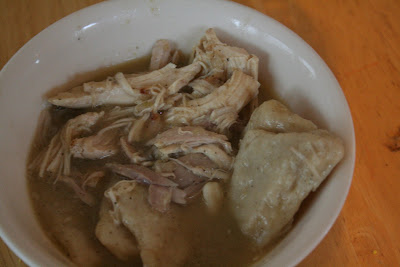
From Chicken and Dumplings

In rural North Carolina, people make "chicken and pastry," rather than "chicken and dumplings." What they refer to as "pastry" is a homemade sort of pasta made from flour, salt, and pepper. Ames makes it with her mother's recipe, but I've made it a couple times using the "Granny's Chicken and Pastry" recipe from Carolina Country. I've made some really good chicken and pastry with that recipe, but I've never been able to follow it exactly. The pastry dough in that recipe always comes out way too stiff.

But I admit I prefer softer dumplings to true Southern "slippery noodles," and so I've mucked about looking for a good way to make those. I've referred to Alton Brown's recipe from Feasting on Asphalt: The River Run, but I've never tried actually following it. My "recipe" is as follows:

Today I used a whole chicken, I generally just use chicken thighs:

  • 1 chicken
  • 2 medium onions, chopped
  • 1 quart water
  • 1--2 quarts chicken broth
First saute the onions in a large pot. I like to cook them in bacon grease, but butter would work as well. Chop them fine, put them on to cook with plenty of salt and pepper (I never measure, I just use enough). When the onions are all transluscent, set them aside and put the chicken in the pot. I've done the chicken in the oven and on the stovetop: I'm not really sure which is better. Today I put a whole chicken in the pot, brushed it with olive oil, salt, and pepper, and roasted it at 385F for an hour.

From Chicken and Dumplings

Once the chicken looked about done, I pulled it out of the oven and put it on the stovetop. I added the onions back to the chicken, put about a quart of water on it, and got it to a rolling boil for about 45 minutes. When the chicken was easily pulled apart with a fork, I removed it from the heat.

From Chicken and Dumplings

Now's the tricky part: we need to pull the chicken from the bones, and we need to make dumplings. So I generally take the chicken out of the pot and set it aside to cool. In the meantime, I get the dumplings going.

Dumplings:

  • 2 Cups flour
  • 3/4 tsp salt
  • 1 tsp pepper
  • 1/2 tsp baking powder
  • 1 tbsp shortening
  • rice milk
That's actually pretty close to Alton's recipe.

From Chicken and Dumplings

I mix the dry ingredients in the mixer and hit them with the whip attachment to get them blended. Then I cut the shortening into the mixture. Finally, I pour a small amount of rice milk (chicken broth, milk, or water would work just as well) into it until I get a sticky dough. This gets rolled out and cut into 1" X 1" squares.

From Chicken and Dumplings

There's never enough broth left from a chicken, so I always end up topping it up. I add about another two quarts of water and then add chicken base to make up a broth. If you have chicken stock lying around, that'll work even better. So now we've got dumpling dough cut into squares and about three quarts of broth: it's time to get them dumplings cooked.

From Chicken and Dumplings

The trick to cooking the dumplings is to get them into boiling broth as quickly as possible, without losing the boil. So I get the broth to a very strong rolling boil and start throwing dumplings in. I find I can easily throw in a handful at a time without having any trouble; but if the boil slows to a simmer, let it get going again before putting in any more. If you're making southern-style pastry, it only takes 15 minutes to get them cooked; but fatter dumplings take longer, say 30 or 40 minutes.

From Chicken and Dumplings

While the dumplings cook, get all the chicken off the bones. I probably throw away too little, but this time Ames picked the bones for me and the meat looked great. When the dumplings look done, add the meat back in.

From Chicken and Dumplings

So that's it. It's not really that hard, but it takes most of a day: there's a lot of "hurry up and wait" with chicken and dumplings. But it's the most comforting comfort food I know, and it's well worth the day's investment to make it right.

From Chicken and Dumplings

Postscript: I got the idea of roasting the chicken in the oven from an episode of "Diners, Drive-ins, and Dives" where they visit Dish, a restaurant in Charlotte about a mile from where I used to work. I generally do the chicken entirely on the stovetop, but when I saw this video, I decided to try the oven. There's an excerpt from it on YouTube: http://youtu.be/BEM2MQoaFH4

Tuesday, April 15, 2008

Trailer Park Gourmet, Pt. 3

In this third installment of Trailer Park Gourmet, I want to discuss a subject near to my heart: Pizza.

I've long been a fan of this particular food, but have recently had some epiphanies about it that seem worth sharing.

First we need to clarify our terms: "Pizza" is a fairly vague word. It can refer to the nouveau creations so many yuppie art-house restaurants around here create, or it can refer to the greasy fare of the college student. I am personally not a fan of the art-house versions, although there are notable exceptions. My concept of "pizza" is fairly traditional: some bread topped with some form of pureed tomatoes, topped with some cheese or cheese-like substance, along with optional toppings.

I don't claim to be an expert on pizza, but I have enjoyed many pies in my life, and want to share a layman's opinions on them. Take these opinions for what they're worth.

There are many styles of pizza. Here in the USA, there are a few well-known styles, typically named after cities. New York pizza is built on a thin but chewy crust, and are generally huge. Chicago pizza is more like a pie: it's got a "deep" crust, which might not actually be thick, just deep. St. Louis pizza is smaller than New York pizza, and while it's also on a thin crust, the crust is actually crisp rather than chewy.

Of those, I like the New York style best, but I very much enjoy a deep dish pie when I can find a good one. I'm unimpressed by St. Louis pizza in general, although there was an excellent shop across the street from our apartment, called Smugala's. I could go back to Smugala's.

But here are some pizza principles I try to live by:

  1. Good pizza doesn't need toppings You can put toppings on a good pizza, but a pizza made with fresh ingredients by someone who knows pizza doesn't need toppings to hide the flavour of the pizza itself. When I order pizza from Domino's or Papa John's, I order them topped. Those pizzas are chain pizza: they're not the expertly created pizzas I can get from locally-owned pizza shops opened by immigrants from Brooklyn. That's not to say they're bad, but they're in that mediocre range where a weak pizza needs some help from toppings.

  2. Larger pizzas taste better. I typically order the largest pizza a store makes. This is not greed: it's a trick I've learned from empirical study. Larger pizzas taste better. There is a very simple explanation for this phenomenon, but it took me some time watching cooks make pizzas before I figured it out. Pizzerias make their dough in advance and store it until a pizza is ordered. Since they have no idea what size will be ordered, they make the dough into uniformly-sized balls. Large pizzas contain the same amount of crust as small pizzas, but the dough is stretched thinner. The difference lies in the toppings, sauce, and cheese. It takes more sauce, cheese, and toppings to cover a larger pizza; so large pizzas have a much higher topping-to-crust ratio. Unless the main attraction of the pizza is the crust (and it may be for some people), the flavour comes from the toppings. So larger pizzas taste better.

  3. I leave my crusts on the plate. Unless you buy whole-wheat pizza, the crust is the most filling and least nutritious part of a pizza. It's also got the least flavour. I always leave mine on my plate.

  4. Pizza with toppings almost always needs bacon I've had good vegetarian pizza, I've had many good pizzas of different types. But unless you specifically know that a given pizza place makes a good pizza with the toppings you want, you need to add bacon. Simply put, bacon is the simplest pizza rescue technique. Bacon makes bad pizza edible and good pizza amazing. The second most important pizza topping is black olive. If you have bacon and black olives on a pizza, you're almost certainly going to have a good pizza, regardless what else you add. One caveat: if you like anchovies, you might not need bacon too. Together they tend to turn a pizza into a salt lick.

  5. Pineapple is under-rated Vegetarian pizza without pineapple is like North Carolina without barbecue: it's possible, but why? And meaty pizza can frequently use some pineapple too. I think there is a prejudice against pineapple because it's associated with little kids, but it's wrong. I proudly stand as a pineapple pizza eater.


So there are just a few pizza principles. I'm by no means an expert, but I take food seriously, and I can't help thinking my pizza-eating experiences are richer for following those guidelines.

Saturday, May 19, 2007

Trailer Park Gourmet, Pt. 2

Since leaving Vancouver Island, I've lived in a couple different places in the USA: a couple in the Midwest, and now in the South.

I already mentioned indigenous Vancouver Island fare: the casserole. We won't mention indigenous Midwest food: I personally found the food in the Midwest to be almost inedible; although to be fare (heh), the people are very nice.

But here in the South, trailer park gourmet means, you take some form of meat, coat it in some form of flour, then cook it in hot fat. That's right, you need to fry in the South.

Of course, Southerners also excel in grilling. It's not at all atypical to sit down to a meal in the South made almost completely either by frying or by grilling. I may or may not discuss grilling at some point in the future; right now, I want to discuss frying.

If you've never eaten fat back, you've never experienced the South. What's fat back ? you ask. It's basically salt pork, but with no trace whatsoever of any meat (well, they're not exactly the same: salt pork is from the belly of the pig, fat back is from the pig's back). That's right, it's just cured pig fat. How do you eat fat back? There are a few different ways, but I prefer it deep-fried.

Yup, here in the South, we actually eat deep-fried pig fat. And if we really want to get good flavour, we fry it in lard.

We also use it to season vegetables. In fact, I doubt very much that a true Southern vegetarian exists: if you eat vegetables in the South, you're eating meat; or at least you're eating the fat from the meat.

So what sorts of things will a Southerner deep fry? Here's a short, incomplete list:
  1. Chicken. Every Southerner will eat fried chicken. In fact, I wouldn't be surprised to find out that Southern vegetarians define chicken as a vegetable, so they can eat it fried.
  2. Turkey. Thanksgiving turkey is frequently cooked in the deep-fryer. Of course you can still have gravy: you use a combination of the oil from the deep fryer and the giblets to make a gravy. You can't eat turkey without gravy.
  3. Pork chops. Yup, nothing like a battered, fried pork chop. My mother-in-law refers to this as a "light meal".
  4. Fish. Southerners love fresh fish, but they only eat it deep-fried. I have no idea why they care if it's fresh, since all they plan to do is batter it and fry it anyway...
  5. Frogs and frog legs, gator, snake. Need I say more?
  6. Organ meat. Chitlins, chicken gizzards, chicken livers, you name it.

The moral of the story is, if it ever walked, crawled, flew, jumped, hopped, or swam; you can deep fry it.

But frying isn't limited to meats, you can also fry your cornbread, your hushpuppies, even your vegetables! Frying is an art form in the South.

I've noticed Southerners take certain health precautions to make up for the impact all that fried food has to have on their bodies. So far as I can tell, the precautions mainly consist of the following:
  1. Large amounts of cola. We all know a nail left overnight in a bottle of coke will dissolve: Southerners leverage that power to help them digest the largely indigestable fried food they live on.
  2. Large amounts of sugar. We all know sugar can give you heartburn and acid reflux. That's right: sugar increases your stomach's ability to digest. Once again, Southerners lead the rest of America in natural health remedies.
  3. Dipping snuff, chewing tobacco, smoking. Southerners tend to use a lot of tobacco. This is almost certainly because the curing affect of smoke helps them digest the fried food they eat.

My mother-in-law has a number of wonderful recipes. All of them start with "Take a little of the oil you used to fry your chicken". Fried chicken oil is the basis of gravy, potatoes, collards, and all forms of Southern gourmet cuisine. Indeed, all good things come from fried chicken oil.

If you don't live in the South, you can still enjoy fried food! You only need to obtain some oil, a suitable vessel for frying, and a heat source. Personally, I dislike the smell of frying, so I only fry outside. I used to use a wok on my grill, but I've now settled on a turkey fryer: a propane-powered burner with a huge stockpot. My fryer's capacity is in the several gallon range: enough to completely submerge a decent-size turkey in boiling oil; although I've never personally fried a turkey. But we did make some awesome fried chicken in that fryer a couple weeks back.

How did we make that chicken? Well, we started with my mother-in-law's recipe: "Take a little salt, a little pepper, a little flour, and put it on your chicken, then fry it". So we mixed up salt, pepper, and flour with a little water to make a paste. Then we put the paste in a Zip-Lock bag, and put in the chicken, a piece at a time, and made sure it got good and covered. We heated up our fry oil to around 400F, and dropped in the chicken.

Now the key is to keep the oil temperature constant. So I kept an eye on the thermometer, adjusting propane flow as needed. Twenty minutes later, we pulled out the fired chicken: it was moist, tender, and slightly crispy. Excellent.

Now, one thing every Southerner will tell you is, food safety is your top priority. So you need to keep your oil clean and fresh. Personally, I change the oil in my turkey fryer about once a year, whether it needs it or not. You can't be too careful about food safety.

Saturday, May 12, 2007

Trailer Park Gourmet, Pt. 1

I might well be the world's foremost authority on casseroles. Yes, casseroles. I grew up on Vancouver Island in the 70s and 80s, and that meant one thing: casseroles. I left the Island in the early 90s, and I've endeavoured to avoid casseroles since. Now I live in North Carolina, where casseroles are much more rare; but every once in a while, a casserole makes an appearance in front of me. Not wanting to be rude, I eat it with whatever relish I can muster. But I have to say, southerners just plain don't excel in casseroles like northwesterners do. And frankly, that's a good reason to live in the south.

For some strange reason, women like casseroles, while men hate them. I wonder why that is?

Casseroles all share four essential ingredients: without any one of these ingredients, it can't properly be called a casserole: a carbohydrate , a vaguely pseudo-cream substance, some form of meat, some type of cheese. These are the four essential ingredients of the casserole, but they do not make a true casserole. Here in the south that might be enough, but in the madly demanding land of casserole perfectionism, Vancouver Island, there are two additional requirements: it must be cooked in a glass vessel, and it must be cooked at 350F.

Let's consider each of these attributes---the quintessence of the casserole, if you like---in some detail:
  1. The carbohydrate. All casseroles are based on some form of carbohydrate. This would typically be macaroni, but any carbohydrate will really do. Women who are trying to disguise a casserole as food will occasionally use a non-macaroni carbohydrate: potatoes or rice are frequently chosen for this decpetive role. There is an old proverb that once a person goes from making tuna casserole with macaroni noodles, to using spaghetti or linguini noodles, she has taken the first step to casserole enlightenment. Well, not really, but I think it's true in any respect.
  2. The cream. Not real cream, of course. Real cream wouldn't work in a casserole: it must be a pseudo-cream substance. Tinned cream soup is the typical ingredient: the "gold standard" of cream soup for casserole would have to be cream of mushroom; but my vast experience in casseroles suggests that a more subtle flavour is possible with cream of celery. Either way, Campbell's Soup should only be used if there isn't a store brand readily available.
  3. The meat. I suppose any meat would work, but the true casserole gourmet knows that if the meat didn't come from a can, it's not going to be the ultimate casserole. The superior casserole must use the most un-meaty meat available: tinned tuna or chicken are good choices, sausage is also an excellent choice. I suppose spam would be the ultimate casserole meat.
  4. The cheese. Every casserole cook aspires to be worthy of using Velveeta in her casserole. Some actually attempt this before their training is complete, showing themselves to be inferior casserole cooks. In any case, casseroles thrive on cheaper cheeses. Store-brand cheddar is a safe choice. Once you have mastered cheddar, work with Velveeta, but do so cautiously, humbly: many casserole chefs seeking enlightenment have fallen on that very peak.
  5. The glass vessel. A casserole cooked in anything other than a glass cake pan is a casserole doomed to mediocrity. The true casserole is a glasserole. It must be cooked in melted sand.
  6. The temperature. A casserole cooked at any temperature other than 350F is simply not a casserole. And the true casserole gourmet knows, even those casseroles cooked on the stove-top are incomplete without being shovelled into a glass pan, covered in cheap cheese, and cooked for a nominal time frame at 350F. If the cheese didn't melt at 350 degrees, it's not truly a casserole.

Now, there are any number of pseudo-casseroles out there. To the uninitiated, there are similarities that seem compelling. But to the Vancouver Islander, these are mere chicanery:
  1. Lasagna. On the surface, lasagna seems like an Italian-themed casserole. But let's be honest: it lacks the pseudo-cream substance. True, those who attempt to subvert proper casserole taxonomy have been known to add ricotta in an attempt to make it more creamy, but the distinguishing palatte can taste the difference reliably.
  2. Pizza. The spirit of pizza is the antithesis to casserole, but there are those would would subvert the truth. Have you noticed how pizzas with cream sauce have been rising in popularity? For the moment, pizza is safe, but when the fad becomes "white pizza" cooked at 350F on glass plates, I shall certainly swear it off.
  3. Scalloped potatoes. To be frank, scalloped potatoes are similar to casseroles in almost every way. As a result, I went many years without eating them. But now, I cook scalloped potatoes with gusto, always careful to make them non-casseroles with the following careful adjustments: I use heavy cream, I cook them well over 350F, and I typically use chicken stock, rather than pieces of ham or bacon for flavouring.

For anyone who likes casserole, the six essential points above might help you develop new casseroles. Let's consider a couple variations that might be worth a try for a casserole-eater:
  1. Middle-eastern casserole: Cook two cups of couscous, lay it in a glass dish, cover in one can of cream of chicken soup. Saute two chicken breasts with rasins, almonds, cumin and cinnamon. Lay the chicken in the dish, cover with cheddar, and bake at 350F for 15 minutes.
  2. Thanksgiving casserole: layer leftover mashed potatoes and stuffing in a glass dish. Put leftover turkey on the mashed potatoes, cover in cream of mushroom soup and cheddar, bake at 350F for 20 minutes.
See? It's easy to make new recipes. By the way, if you actually try those recipes up and they're edible, leave a comment. I just made them up, but you're welcome to use them.

My wife was mentioning that she never got the recipe for an (admittedly excellent) "Breakfast Casserole" a friend served us a few years back. I looked at her and said "I'll tell you exactly how to make it!". I mean, it's a casserole...