Thursday, August 3, 2023

Running into Molly

I was walking back from an [unsuccessful] hunt when I came around a corner and saw what I thought was a huge cow elk in the middle of the trail. I couldn't believe there was an elk within a short walk of where I had parked: I had been hiking up hill and down looking for one for several hours.

But a second glance made it clear she wasn't an elk. Her face wasn't the right shape, she wasn't quite the right color, and she was far too tall. I actually exclaimed, "You're a moose!" as I stepped backwards. It's not a good idea to crowd a moose cow, especially if she has a calf with her. I couldn't have been more than 50 yards away, probably less than that.

She stared at me for a couple seconds, then turned to leave. Sure enough, a calf stepped out of the bush to join her as she left.

We don't see a lot of moose around here: maybe a couple every year. This is the second time in two years I've run into a moose while hunting elk. Last year, a bull rushed up the side of a ravine and stopped about 100 yards from my buddy and me. I don't think that bull ever figured out we were there. My buddy and I watched him for a bit, standing on the bank of the trail, long beard swinging side to side as he looked both ways before crossing.

 Nothing runs uphill like a moose. They're unbelievably fast.

I generally think of the "interesting" creatures being pretty far up into the hills and much further back from the humans in late summer and early fall. But there was Molly Moose with her calf, hanging out no more than a quarter mile from my truck.

Sunday, October 18, 2020

Dancin'

The chickens are right at six months old now. We're getting just over a dozen eggs every day from our hens. Two or three of those are full-sized eggs, but the majority are smaller, and some are quite small. So they're exactly what we expect pullet eggs to be. 

We still have 23 hens and 5 cockerels. While the rooster roster hasn't changed, we've seen several developments in the social order. Barred Rock Hudson is certainly at the top of the pecking order, and King Louis is at the bottom. The three New Hampshire cockerels are harder to pin down. Rooster Cogburn was for a long time the largest of the roosters, and he seemed to be vying with Hudson for the top spot. But Cogburn has fallen at least one rung on the social ladder now. The other two New Hampshire cockerels, Little Jerry and Cosmo, are a mystery to me. Little Jerry is now the same size as Cogburn, slightly larger than the dominant male. Cosmo is slightly smaller.

Uncle Harvey contrasts "dancing roosters" with "rapist roosters." The former perform a chicken mating ritual, dancing around the hens to invite them to mate. The "rapist roosters" simply grab hens that catch their fancy and try to forcibly mate them.

Rooster  Cogburn was the worst of "rapist roosters," actually lying in wait around corners for a hen to pass, then grabbing her and mating with her while she shrieked and squawked indignantly. Cogburn was so bad, even my most tender-hearted daughter reluctantly agreed we needed to cull him. But two amazing things occurred to keep me from culling him, and I'm glad they did.

First, Barred Rock Hudson took control of his flock. Hudson spent at least a few weeks entirely devoted to rescuing hens from Cogburn. A hen would cry out, and Hudson would charge over and attack Cogburn. Cogburn would then typically run off, away from the flock, and wait for another chance. Strangely, both Little Jerry and Cosmo began to act as Hudson's deputies, chasing Cogburn off whenever a hen would cry out.

Second, Cogburn learned to dance. Cogburn was the first of our roosters to start dancing for the hens, who would generally ignore him. But one day, I noticed that there was a Barred Rock hen hanging around with Cogburn away from the rest of the flock. He started dancing for her, and she accepted his invitation without the slightest fuss. I started paying attention at that point, and saw the two of them go through this ritual at least four times over the next hour.

As Victorian as it sounds, Cogburn got a girlfriend, and she reformed the rake.


Wednesday, June 24, 2020

Chicken Salad

This spring I ordered 27 birds from Murray McMurray Hatchery. They added two to the order, and 29 were delivered near the end of April. We lost one on the fourth day, but the rest are doing well – 28 nine-week-old chickens living in our backyard.

back yard chicken coop

Our attempts at landscaping around the coop haven't been very successful yet. I'm seriously considering dumping foot-deep mulch all around the outsides.


There's one barred rock cockerel who seems to be growing up fast. At nine weeks old, he practices crowing every morning around 4:30. We call him Barred Rock Hudson. They're still very young, and barely adolescent, but Barred Rock Hudson appears to be the dominant male.

Barred Rock cockerel

The second-in-command is a New Hampshire cockerel who's significantly larger than Hudson, but seems to back down whenever they have a confrontation. I've taken to calling him Rooster Cogburn.

New Hampshire cockerel


Murray McMurray includes a "Bonus/Free Exotic Chick" in their orders, so we have a Polish cockerel as well. When he was only a couple days old, he looked like he a pre-revolutionary French courtier in a ridiculous wig, so we took to calling him King Louis. Now he honestly looks more like a punk rocker, so perhaps he's more "Louie" than "Louis". The poor guy has his head pecked mercilessly by the others, but we're afraid seperating him will do more harm than good, so we keep coating his head with balm.

Polish cockerel


All told, we have five cockerels, although it's possible another is lurking in there. But Hudson, Cogburn, and Louis seem to be the three at the top. There are two more smaller New Hampshire cockerels, but they seem to be pretty timid.  Louis is definitely lower on the pecking order than Hudson or Cogburn, but I've seen him stare down almost everyone else.

The plan is to let the chickens roam freely during the day, but so far I've been limiting their "free range" time to a couple hours in the evening. The cockerels are still quite small, and still don't seem to understand their role in the flock. There's a lot of predator pressure out here, and I'm not quite ready to delegate the care of the flock to them yet.

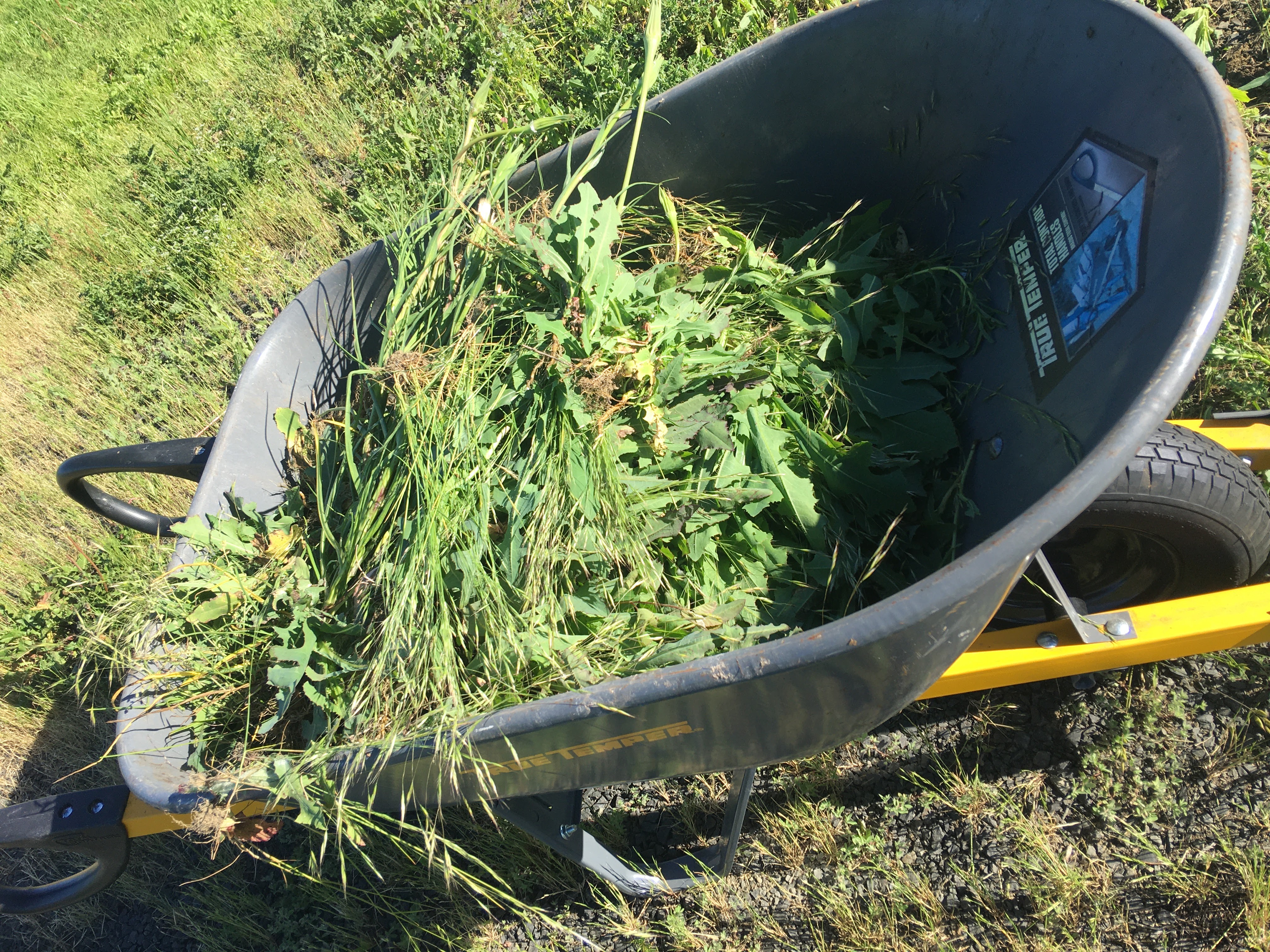
So I end up doing some of their free ranging for them: pretty much every weed I pull up I toss into their coop to see whether it interests them. They definitely won't eat thistles (which is a pity), but they love dandelion, milkweed, and clover. The jury's still out on sourgrass, and as much as they like hawkweed, I'm letting them find it themselves: it's too hard to pick.

I now spend a lot of time making salads for my chickens.

wheelbarrow full of weeds


They do seem to love their salads. And it's not too hard to figure out what they don't like – they leave that on the floor of the coop.


Sunday, May 3, 2020

+2

So we finally went back to the nursery where we bought that Green Gage plum last year. I couldn't find any more Green Gage trees, so I asked. No, they didn't have any Green Gages this year. So we thought we'd perhaps pick up something else.

While we were outside, the young woman who seems always to be there came up and told us she had found two Green Gage trees in their clearance area. And of course I knew exactly which trees they were...

Last fall we visited the nursery in mid-October, just two weeks before they closed for winter. They had three of the Green Gage trees I wanted, priced at $89 each. Since they were about to close, they had marked them down 25%. So I bought one, and kept wondering if I should have bought two. And all through the winter, I'd see the two trees I hadn't bought, standing tall and alone in the cold...

So this week, those same two trees had been marked down to $20 each. They were in full bloom, and had a lot of bees buzzing around them. They were bursting out of their pots, but they had made it through the winter.

So now they're in my back yard. They seem to be in decent shape, despite having been brutally root bound. They're at least ten feet tall, so I'm not fearing for them as far as the deer are concerned. And I got both of them for less than the discounted price I would have paid last fall.

Of course they're probably more stressed than they would have been had they been in the ground all winter, but they seem to be doing fine.

So that's a win.

Thursday, March 19, 2020

Attrition

When I was growing up, my dad had something like 14 fruit trees in the back yard, not counting nuts. There was an Italian prune plum tree, a Green Gage plum tree, a couple cherry trees, and several apple trees. My two favorite apple trees were the Northern Spy and the Cox's Orange Pippin.

Now that we're living in the middle of nowhere and have a little more room, I've been working on planting a small orchard of my own. We've planted a couple Italian prune plum trees, a couple Cox's Orange Pippin trees, and even a Green Gage plum tree. It's been very exciting.

I would have saved time and energy if I'd just have taken a couple of those trees, chopped them into small pieces, and left them out for the deer. They ravaged the Cox's Pippin tree we planted, reducing it to a bald stick with a few pathetic, broken branches. They ate most of the branches off the MacIntosh tree, leaving it sadly unbalanced. The Italian prune trees seem to have survived the best, but even they ended up with just a small handful of leaves. They looked like spindly skeletons.

Interestingly, the deer seem to have done almost as much damage in the spring as in the winter. The trees looked much better in March than in July.

So last fall, we planted a couple more trees, which we protected with "fences" made of hog panels. Those have fared better (so far). The Green Gage was by far the most mature tree we've planted, and the deer appear to have left it alone entirely. We planted a second Cox's Pippin and a cherry, both in wire fences. Both have been left alone.

To be fair, we've had a mild winter (so the deer haven't been desperate), and we now have a dog. I think the dog has had a bigger impact on deer raiding our trees than I have realized.

So now I realize I'm in a war of attrition with the deer. I'm going to have to plant trees in great enough quantities that I can afford to lose one or two to the deer. Most of the varieties I've been planting require at least two trees for fruit, so I've been budgeting at least three trees per variety. That means I can lose one to deer and still get fruit. And when deer season rolls around in the fall, I'll try to recoup some of my losses in venison.

So yesterday we planted a couple Northern Spy trees, and I have a couple more cherries to plant over the next few days. That brings the tally up to eleven trees total, but I want to get at least one more Green Gage and another Cox's Pippin before it gets too warm. I'm hoping to get the total fruit tree count up to 15 by fall.

I haven't given up on the trees the deer ravaged: we fenced them in and fertilized them and mulched them. I'm hoping they recover, but I also realize we've lost at least a year or two of productivity on them.

Saturday, December 28, 2019

Sawbuck

Now that we're living in the middle of nowhere, and heating with wood, our priorities have begun to shift a little. We're burning through wood faster than I expected; that's not the best news, but we have plenty of dead trees – seasoned firewood! The problem lies in getting them out of the back yard and into the wood pile.

Of course we don't want to burn unseasoned wood, but the wood that we know has been down for at least a year is eligible for immediate burning. Wood that's too old we can still burn in a firepit, but we don't want it in our stove. Wood that's still green is worth processing for next year, but it's a mistake to try and burn it too early.

We've processed wood with axe, bow saw, and chainsaw. The chainsaw is the fastest, the bow saw is the most exercise. I finally gave in and built a sawbuck to get the wood up off the ground so I can get a good angle with either saw.

I made the sawbuck from six eight-foot 2x6 boards. There's almost a complete board left over: I had planned to use half of it as a stringer, but there are already three stringers on it, and it's heavier than I wanted.

The construction is simple: the three uprights are made from two four-foot lengths joined with a carriage bolt. I drilled a 3/8" hole in the center of each board, 30" above the bottom. Then I ran a 3/8" carriage bolt through each pair. Each upright has the bottom inside corner cut off at 30° to make it more stable.

There are two pieces on each upright section cut with a 30° mitre at each end: they're 12" long on the bottom. Those are to fix the uprights at a permanent angle. They're fastened in with 3" long decking screws.

One is butted up to the front leg and screwed to the back, the other is butted up to the back and screwed to the front. They're screwed together in the middle. I thought of gluing them together, but I think the screws will hold just fine. The idea was to keep the legs at a fixed angle, and "fill in" the gaps to make it easier to assemble the sawbuck.

The stringers are just 48" 2x6 boards attached with decking screws to the legs. I cut four stringers, but only used three because of the weight.

I'm surprised how much better it is to cut on the sawbuck. And the 2x6 weight, while difficult to move around, makes the whole system stable, even when bucking logs with a chainsaw. Now I'm wondering why I waited so long to make it...

Tuesday, October 1, 2019

Woodstove

This last summer we moved from the city into the country. We're no longer able to see and hear everything our neighbors are doing, which I consider a pretty major improvement.

One of the complications with our new situation is that we're now living in a bit of a snow-belt, and our poor house isn't really designed to handle that sort of weather. So one of our first orders of business was getting a reliable source of heat.

Just to give you an idea: it's October 1, and we've already had our first snowfall this year. It all melted within a few hours, but it was a liberal dusting of snow. The hilltops around us stayed snowy for a couple days. It's looking like a cold winter.

Being out in the middle of nowhere, a wood stove was definitely an option. And the more time we spent researching and mulling it over, the more we realized that was probably the right choice.

So we bought a wood stove:

We spent more time than I expected on finding the "right" stove, but it was installed surprisingly quickly once we made the choice. The stove is a Hearthstone Heritage TruHybrid.

I didn't like the look of the stove at first: I thought it looked like someone had glued stones to a squirrel to make a turtle. But I admit it's grown on me. It's built out of blocks of soapstone on a cast iron frame. So it's very heavy, and it takes a long time to warm up.

The "TruHybrid" system is actually a "catalytic combustor" system. There's a catalytic reactor in the "ceiling" of the stove that burns the smoke from the fire in order to make the fire hotter, reduce the smoke, reduce the emissions from the stove, and clean the burn. This isn't just injecting air into the top of the stove for a secondary burn – this stove does that as well – it's actually a tertiary burn.

I grew up with wood stoves. My chores included splitting wood, cutting kindling, and bringing armloads of split wood into the house to fill "the wood box." But the wood stoves of today aren't the glorified cast iron boxes of my youth: they're a great deal more complicated, and it took us a while to figure out how to use the new stove.

So here are some things I wish someone had told me about the Hearthstone Heritage IV before I got one:

  1. The soapstone really works. It does. It is frequently warm to the touch ten or twelve hours after the fire has gone out. This stove is almost more a wood-powered radiator than a wood stove.
  2. We have the optional blower installed on the stove. The blower is heat-activated, so it won't come on unless the stove is hot to the touch right near the blower. The blower will turn off when the stove cools down. The blower is a little loud, but we just turn it down during the day and turn it back up at night.
  3. The Hearthstone manual isn't terribly helpful when it comes to troubleshooting. It might even make things worse. The manual gives dire warnings about "over-burning" the stove, and how it voids all your warranties if you burn it too hot. The problem is... the stove won't start unless it's hot. More on that later.
  4. The glass door is a nice touch, but it smokes terribly when you open it: the side door isn't a gimmick, it's the only way to get the fire going without smoking out your house.
  5. The glass door gets messy, but the recommended cleaning technique in the manual actually works: wet a cloth, dip it in the ashes in the stove, and it'll wipe the creosote right off the glass.
  6. The stone on the stove takes forever to warm up. It can be cool to the touch while there's a blazing fire inside. This means the stove will smoke like a cold stove for a very long time. This is one smoky stove if you're not careful.

The biggest challenge with this stove is getting it lit. The stove is designed not to operate at low temperature, because they want it to run clean via the catalytic combustor; and the catalyst doesn't work unless it's hot. But because the stove is stone, and it takes so long to heat up, it's a real challenge to get the fire actually to light. As long as the stove is cold, it won't draw air, and your fire will die in billows of smoke.

The solution is to start with a much bigger fire than you think you need. You need to get a hot fire going as quickly as possible, so that the stove will stop smoking and draw in fresh air. Of course you're worried about shocking the stone and cracking it. And you're worried about over-burning your stove and voiding the warranties. But if you don't get the biggest fire you can in the stove as early as possible, it won't ever light – you'll end up with a smoking, cold stove.

So we use a lot of paper, and a lot of kindling. That gets a good blaze going very quickly. We're not even trying to light the wood at this point: we're trying to get the stove hot as quickly as possible. After it blazes up, we keep a door cracked open to get more air to the flames for at least twenty or thirty minutes. Once the stove warms enough to draw, we close the doors.

Now, it's taking almost an hour for the stove to warm to the point that the catalytic combustor can work. But once we get it to that point, we throw the lever and it really takes off. Now that we've figured out the key is a large blaze as soon as possible to get the stove actually to light, our next goal is to get the catalytic combustor working in less than 45 minutes. We'll see how that turns out.

I'm quite happy with this wood stove, but I honestly thought we'd gotten a lemon for several weeks. We just couldn't figure out how to get it to light cleanly. Now that we've cracked that nut, the stove is a dream.

Tuesday, January 22, 2019

Cartridge bag

I wanted to come up with a practical way to carry shotshells while out on adventure. There are plenty of solutions online: I looked at side-saddles that attach directly to the shotgun, chest rigs made from ballistic nylon, bandoliers that sling over the shoulder, and even buttstock covers with loops to hold cartridges. But at the end of the day, almost all those solutions were way more tactical than I wanted. When I head out, it's usually in a wool sweater and oiled leather boots.

The best all-around option seemed to be the leather cartridge bag. It will work equally well for plinking in the woods, shooting in the gravel pit, or hunting during pheasant season. Loaded with 100 one-ounce shells, it'll weigh in around six pounds.

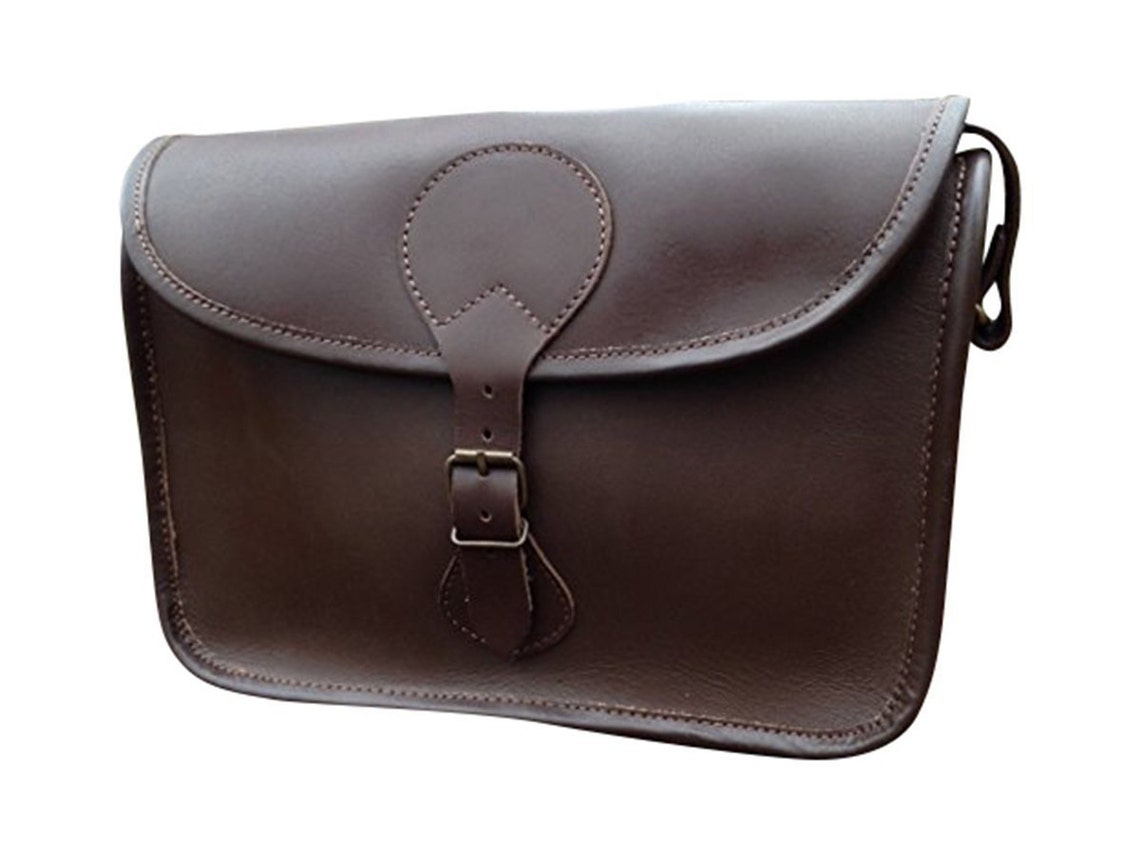
I found this one on Etsy:

It seemed to be exactly what I was looking for.

My biggest concern with ordering this cartridge bag was the fact that it shipped from the UK. I was quite pleased with the entire process. The bag was listed for $51.36 (USD). The final cost (including taxes and shipping) was $63.80 (USD). That's not very expensive for a leather bag.

I ordered the bag on January 2, it shipped on January 3, and I received it January 14. So it was less than two weeks from placing the order to receiving it, and four days before the estimated delivery date.

The cartridge bag looks just like the pictures. The leather is a little thinner than I expected, and the buckles are a little smaller. But the bag is quite sturdy, and I have no doubt it'll last me for many years.

The only thing about the bag I don't like is the leather "drawstring" in the mouth of the bag. It's leather, but it's quite flimsy. I expect I'll end up pulling out that leather thong.

The listing says the bag holds over 100 cartridges. I emptied two boxes of shotshells (50 cartridges) into the bag, which filled the bag about half-way. So it seems like 100 cartridges is about right. I noticed the bag held more when I turned all the shotshells to lie in the same direction: when I just dumped the two boxes' worth of shells into the bag, they filled it more than half full.

The leather feels a little too stiff, but I think after some use and some leather treatment, it'll be great.

All in all, the bag is well worth the price. It was delivered on time, and I'm quite excited to take it out on an adventure.

Saturday, September 10, 2016

Baptist Chicken

It took me a while to admit to myself that my favorite meat is chicken. Well, grouse is better than chicken, but they're pretty close to the same thing. My favorite way to cook chicken is what we have termed "Baptist Chicken". That is, chicken that's first grilled then immersed in sweet sauce. The key is to coat it by immersion only after it's fully cooked.

It's real barbecue: we cook it in smoke at around 200° F. But chicken cooks pretty quickly: a whole chicken is completely cooked somewhere between four and six hours. When we're doing Baptist Chicken, we generally use legs and thighs.

With the Big Joe, Baptist Chicken has become the perfect slow-cooker meal. The Big Joe maintains its temperature beautifully – it once went 35 hours for me at a constant 215°F – nothing could be easier than throwing some chicken onto the Joe and ignoring it for four hours or so.

Let's address the first issue: rubbery chicken skin. Conventional wisdom says you'll get rubbery chicken skin if you cook chicken that low. That's only kinda-sorta true. The key is to cook the chicken directly over the fire, rather than using "indirect heat". On the Big Joe, that means I generally don't use the ceramic heat deflectors for chicken.

The mistake to avoid with barbecued chicken is saucing it too early. You don't want to even think about getting any sort of sugar- or tomato-based sauce on that chicken until it's at least safe to eat, if not fully cooked. If you sauce it too early, you'll get burned sauce on your chicken.

Once the chicken is entirely cooked, you want thin coats of sweet sauce on it. If you just want to use barbecue sauce from a jar (there's nothing wrong with that), then you'll want to thin it. I prefer to thin it with an eastern North Carolina style of sauce, but you can thin it with vinegar or a combination of vinegar and water. The key is to get it thin enough it'll coat the meat evenly.

So here's how I do it:

  1. I coat a bunch of chicken legs and/or thighs liberally with salt, black pepper, and garlic powder. I use garlic powder instead of fresh garlic for almost every grilling application. Not for souvlaki...
  2. I set up the grill. With my grill, I know that a one-inch opening on the bottom vent plus the daisy wheel set about half-open on the top gives me almost exactly 200°F, depending on the weather.
  3. The chicken goes into the grill, directly over the fire. No heat deflectors, no indirect heat.
  4. I close the grill and ignore it for about four hours.
  5. I thin some sweet sauce. I've had good results using a combination of Kraft Original and Carolina Treet: almost any sauce should work, and a home-made sauce might be best.
  6. I put the thinned sauce in a mixing bowl and immerse the cooked chicken in it, then return it to the grill so the sauce will caramelize.
  7. You can repeat that last step as many times as you like, but you're going for thin coats, not large globs of sugary sauce on that chicken.

We have church pot lucks twice a month, and I live a short walk away. So my new potluck dish is Baptist Chicken. I put it on the grill first thing in the morning, and ignore it until just before lunch. A quick coat and back on the grill, the chicken is ready to eat almost on time.

Sunday, July 10, 2016

Newbie's Guide to Guns, Part 3: Ballistics over-simplified

Here's a quick overview of ballistics, using only high school Physics. It's way over-simplified.

When you shoot a gun (a rifle or a pistol, not a shotgun), the bullet goes through three main stages. First it accelerates down the barrel, then it moves quickly through the air, then it smashes into a target. Let's consider those in terms of high school physics.

When you first shoot a rifle, you feel the recoil: the push of the gun back into you as a reaction to the bullet's speeding off.  If we think back to high school Physics, what we're feeling there is "conservation of momentum". When we're standing still with a gun, the momentum is zero. If the bullet speeds off, it now has a momentum in one direction, so the shooter and the gun have to have the same amount of momentum in the opposite momentum. They have to add up to the zero momentum they had before the rifle was fired.

So momentum is calculated as the product of mass and velocity:

p = m v
A more massive bullet – or a faster bullet – means more momentum. Mass and velocity contribute equally to momentum. The more momentum, the more recoil.

Of course that works both ways: you can make the recoil feel lighter by using a heavier gun.  This is one reason people love the AR-15: the bullets are really fast, but they're not very heavy. The guns aren't super heavy, but the ratio of gun weight to bullet weight means the AR-15 has a much lighter effective recoil than we'd expect.

Once the bullet leaves the gun, it's effectively falling due to gravity and slowing due to air resistance at the same time. Air resistance is more serious Physics than we're going to get into right now – we're not getting into differential equations today!  But even from a high school Physics perspective, we understand air resistance well enough to understand that bullet shape has a huge effect.

In the late 19th Century, bullets were more-or-less round-nosed. Modern bullets are generally "Spitzer", or pointy bullets.  Of course pointy bullets are more aerodynamic, and slow down less dramatically than round-nosed bullets. So older rounds like the ".30-30" tend to have shorter range than really they should, because the shape really slows them down.

The question of a bullet's effective range is really a question of the bullet's ability to carry the energy it gets in the gun barrel through the air. In an ideal world, a bullet would hit its target at the same speed it leaves the gun barrel.  Of course none actually do.

Kinetic energy is calculated as:

E = 1/2 m v2
Energy depends on the square of velocity. In other words, if you double a bullet's speed, it has four times the energy. On the other hand, if you halve a bullet's mass, you only halve its energy. So it stands to reason a lighter, faster bullet has more energy than a heavier, slower bullet – even if they have equal momentum. So two bullets with identical recoil can have widely varying energies.

When the bullet does hit its target, the measurement we're most interested in is energy. We recall from high school that energy is "the ability to do work". So what we want at the end of the bullet's flight is the maximum possible shedding of energy from the bullet into the target. We want the bullet to do the most possible work on the target in what Physics teachers call a "completely inelastic collision". I suppose the perfect bullet would stop dead at the surface of the target and fall to the ground, completely without energy.

When people talk about "terminal ballistics", they're really talking about how quickly a bullet transfers its energy into the target. Probably the single biggest factor is bullet deformation: when a bullet hits a target, it's rapidly and radically reshaped by the impact. The more dramatically the bullet is reshaped, the more work is done, so the more energy is transferred from the bullet to the target.

This is actually one reason people use hollow point bullets for self defense. A hollow point bullet is extremely prone to reshaping on impact, so it sheds a great deal of its energy very quickly. Because a hollow point loses energy very quickly, it tends not to over-penetrate its target. In other words, the probability of a hollow point going through one target into another is very low. In a self-defense situation, this means it's unlikely you'll hit both the bad guy and the innocent bystander behind him. This is one reason police use hollow point bullets.

Of course, this also means hollow points are easier to stop.

Here's a reasonable explanation of terminal ballistics:

So a bullet goes through three main stages, each with its own unique considerations. A bullet that's preferred for one stage might be less preferred for another (e.g. a bullet with excellent terminal ballistics, generally has inferior "flight" ballistics). Sometimes the bullet's mass (or weight) is the most important thing to consider, sometimes the bullet's speed is the primary consideration. And the firearm itself is important too: a heavier rifle means much less felt recoil, for example.

Even at this over-simplified level, ballistics becomes an extremely fascinating study. And we haven't even discussed accuracy yet...

Tuesday, April 12, 2016

Newbie's Guide to Guns, Part 2: Rifle and Pistol ammunition

We saw last time that caliber is a lot more complicated than the textbook definition of "diameter of the barrel in inches": different calibers are actually different specifications of the size, shape, and weight of the bullet itself as well as the powder charge.

One of the places this is most clearly seen is the comparison between pistol and long rifle ammunition. We recall from last time that a 9mm bullet is really a .38 caliber. That means that a .308 Winchester is really a lower caliber than a 9mm Luger.  But  a .308 packs a whole lot more punch than a 9mm Luger.  The difference is quite clearly seen if we look at the actual cartridges.

The 9mm Luger is a reasonably short round


The .308 is a great deal longer

I can't find a picture of them side-by-side, so we'll have to look carefully: although the .308 bullet and the 9mm bullet are approximately the same diameter,  the 9mm round looks much larger in proportion to the cylinder. That's because the 9mm Luger is 19mm long (hence the designator "9X19mm" while the .308 Winchester is 51mm long (recall a .308 Winchester is almost identical to the 7.62X51mm NATO round).

The difference between the lengths of the two cartridges indicates the relative strengths of the powder charges. Not only is the .308 round a whole lot heavier than the 9mm round, it is packaged with a whole lot more powder.

This exemplifies the main difference between pistol and long rifle ammunition: rifle ammunition generally packs a lot more "punch".  The 9mm Luger round is expected to have a muzzle velocity in the neighborhood of 370 m/s (somewhere around 1200 ft/s), the .308 is expected roughly to double that with speeds around 800 m/s.  If we recall our high school Physics class, we'll remember that kinetic energy is proportional to the square of the velocity, so the .308 carries about four times the energy of the 9mm, without taking into account the difference in bullet mass.  We'll discuss that in more detail later.

There are some rifles that use pistol ammunition, like lever guns chambered in .357 Magnum or .44 Magnum. Although they use the less powerful pistol ammunition, they still tend to get a lot more energy out of those same rounds than a pistol would. Why is that?

It actually comes down to the length of the barrel.  When a gun is fired, the bullet is forced down the barrel by the expanding gasses produced by the burn of the gunpowder. Once the bullet exits the barrel, it's no longer being pushed by the burn of the powder, and will begin to decelerate immediately because of air resistance. If two identical cartridges are fired from two different guns, the one with the longer barrel accelerates for a longer distance, exiting the barrel with a higher speed. So the longer barrel almost always means a faster (i.e. more energetic) bullet.

I suppose the effective limit of this rule of thumb would be the maximum volume of the expanding gasses. In other words, the powder doesn't expand to an infinite volume when it burns. Whatever the maximum volume of the powder charge's burn is, that's when a bullet would stop accelerating down a barrel. If the barrel's volume were larger than that expansion, then we'd expect the bullet to decelerate rapidly in the barrel due to the friction of the barrel. But I'd expect a barrel that long would be impractical to carry.

So there are two main reasons a rifle hits harder than a pistol: rifle ammunition is packaged with a whole lot more gunpowder to push those bullets, and rifle barrels are longer, so that even when the powder charges are identical, bullets accelerate longer in rifles and thus come out of the muzzle with a lot more energy.

So the next time you hear someone talk about a .50 caliber pistol, don't assume it's more powerful than a .30 caliber rifle. It probably isn't. Even though it might have a ridiculously large bullet, it probably has significantly less powder, and it almost certainly is coming from a shorter barrel.

Sunday, April 10, 2016

Newbie's Guide to Guns, Part 1: Caliber

I first started shooting as a teenager, in Air Cadets.  We were trained on Lee-Enfield rifles (probably WW2 surplus) [re]chambered in .22LR. Those were heavy rifles for a new shooter! If I recall correctly, they weighed in around nine pounds.

One thing I had trouble grasping for many years was the names of firearm calibers. It seemed to me the caliber names were at best inaccurate, at worst completely deceptive. So let me help dispel the mystery...

A firearm's caliber is named for the diameter of its bullets. So a .22 caliber rifle has a barrel .22 inches in diameter. Similarly, a .50 caliber has a half-inch barrel diameter.  Unfortunately, that's only really theoretically true. Things get a lot more complicated right out of the gate, and we'll look at that.

I suppose in the days of smooth bore muskets, the barrel diameter told the whole story. The bullets were essentially spheres of lead. Given that the density of lead is a constant, and the volume of a sphere is strictly a function of radius, barrel diameter completely described those older bullets.

These days it's a lot more complicated. We now use cartridges that contain both the actual bullet and the powder charge: so we need to describe not only the bullet, but how much powder is behind it. And since we now use non-spherical bullets, the diameter doesn't tell the whole story.

Now we describe bullets by their caliber (diameter) and their weight. Bullet weight is measured in grains, one grain weighs 1 seven-thousandth of a pound. So if you're shooting 115gr 9mm Luger ammunition, you're shooting bullets that weigh 115 grains, or 0.26 ounces, or 0.016 pounds. In other words, they have a mass of 7.37 grams.

But unless you're just buying bullets (for example, you're reloading), you're not buying just the bullet, but the cartridge it comes in. This gets even more complicated, because the size and shape of the cartridge is at least as important as the caliber of the bullet. Guns are manufactured for a specific cartridge, and in general it's a really bad idea to try and use a different type of cartridge in there.

Cartridges are named by many different conventions, and it's not always easy to interpret what those names mean.  When I was small, hunters would talk about their "thirty odd six" rifle, and I had no idea what that meant. What they were really saying was "thirty-ought-six", or ".30-06".  This is the cartridge the U. S. Army adopted in 1906, and it's a .30 caliber. So it's the .30 from "ought six", or ".30-06".

Many cartridges are named for their original manufacturer. Savage Arms invented the popular ".300 Savage" round, a .30 caliber cartridge for the rifles they manufactured. Since Winchester invented the ".30-30", sometimes those are called ".30 Win" or even ".30 WCF" (meaning .30 caliber Winchester center-fired).

I remember growing up, hearing about a "thirty, thirty Winchester".  That is, a Winchester rifle that takes".30-30" cartridges. The ".30-30" means a .30 caliber bullet with 30 grains (0.069 ounces) of [black] powder. Similarly, a ".45-70" is a .45 caliber bullet with 70 grains of powder.  Both those cartridges come from the end of the 19th Century, when the U. S. Government designated cartridges by their caliber and powder charge.

A lot of rifles are chambered in ".308 Win", or the .308 caliber Winchester cartridge. Military rifles might use a "7.62X51mm NATO" cartridge, which is almost exactly the same thing as the .308. If you do the math, you'll find 7.62 mm is .30 inches.  Along similar lines, the AK-47 shoots "7.62X39mm", or a .30 caliber cartridge that's 39mm long.

There are other designators that are used. "Magnum" means over-sized, so when someone talks about a ".357 Magnum", they are referring to a cartridge with a .357 caliber bullet that's "oversized", which means it has too much powder.  You can also buy ".44 Magnum" or even ".50 Magnum" guns.

Probably the hardest thing for me to understand about ammunition was that the names are really only kinda-sorta accurate. Virtually every ".357 Magnum" will shoot ".38 Special" as well. I never understood that, as .357 inches differs significantly from .38 inches. It turns out the .357 Magnum and the .38 Special have the same diameter: .357 inches.  The .38 Special was apparently marketed as .38 caliber, because the cartridge itself was .38 inches in diameter, even thought the bullet was only .357 inches.

Marketing is probably the hugest driver for cartridge names. If you do the math, you'll see that .38 inches is 9mm; but a "9mm" round is quite different from a ".38 caliber" round: they're the same measurement, but the names imply very different specifications.  When someone says they have a "9 mm" pistol, they generally mean it shoots "9mm Luger" cartridges. If someone has a ".38", they generally mean  a ".38 Special".

In the end, when I was told many years ago that "caliber" means "diameter in inches", that's not really the whole story. Cartridge names are really a sort of branding: they refer a specific, detailed design. Diameter is a huge part of that, but there's a lot more to it than just bullet diameter.

Monday, April 4, 2016

Can-Am Pie

Several months ago we were eating butter tarts, and someone suggested it might be interesting to mix butter tarts with apple pie.

I suppose this pie might be a metaphor for our family: Butter tarts are the quintessential Canadian dessert, and apple pie is as American as... well, apple pie. So I'm calling this one "Can-Am pie".

I started with four large Granny Smith apples, peeled and cored.


I squeezed half a lemon over them to keep them white-ish.

Then I made some butter tart filling.

Butter tart filling is a mixture of butter, eggs, brown sugar, and corn syrup.  Like all Canadians, I have a family recipe for butter tarts, but this one was just a recipe I got out of a cook book.

One of my current fascinations is raised pie, so I decided to put this one in a hot water pie crust. I used a spring-form pan to shape the pie.


I poured the entire batch of butter tart filling into the crust, then put the apples on top, sprinkling them with cinnamon and white sugar:


I covered the pie, then baked it for 45 minutes. After 45 minutes, I took the pie out of the pan and brushed it all over with egg wash, then baked for another 15 minutes.


Tuesday, January 19, 2016

Reading

I've been trying to salvage some of my commute time recently: I spend far too long every day on trains and buses.  I've read five books in the last month or so:

  1. Can Man Live without God? by Ravi Zacharias
  2. The End of Reason by Ravi Zacharias
  3. The Dust of Death by Os Guinness
  4. Willpower: Rediscovering the Greatest Human Strength by Baumeister and Tierney
  5. More Guns, Less Crime by John R. Lott, Jr.
I'm afraid I'm still only about 20% of the way through Calvin's Institutes. I'm not procrastinating on finishing it, I've just been more interested in other books recently.

Thursday, July 16, 2015

Barbecuen' in Ceramic

One thing that's always appealed to me about a Kamado grill is that they're pretty much airtight. Ultimately, controlling airflow is the single best way to control temperature in a grill. You don't need to control airflow to control temperature... you can play the sorts of games I've played, like propping open the lid with a chunk of a 2X4


But that isn't really best. For one thing, it's not really addressing the burn rate of the grill: so what I was effectively doing was burning a fire far too hot, then throwing away the heat from the fire in order to keep the temperature where I wanted it.

The Kamado, on the other hand, allows me actually to slow down the burn rate. So it's not merely that I'm keeping the grill down to 200°F, but I'm reducing the size of the fire. Very cool stuff!

I've tried a couple times to do barbecue to on my new Kamado. The first time, I followed the conventional wisdom the Kamado community follows and set up my grill with the ceramic heat deflectors just above the fire, then set up the cooking grates over that and put a pig shoulder on the grates.


The pig shoulder was done in about 20 hours, and I was very happy with it. The pork was smoky and tender.


Best of all, I didn't have to do much with it. The Kamado pretty much held the temperature for the whole time.

But... I missed the flavor of barbecue cooked directly over the coals. The question I was asking was, "Can I cook directly over the charcoal, but keep the temperature low?" The answer is, yes you can!

So on July 3, I fired up the Kamado and set it up for 215°F.  I got the Kamado going around 7:00 AM on July 3, and it ran until about 6:00 PM the next day. 35 hours of a 215°F cook without reloading the charcoal. Oh yeah!

In that time, I cooked chicken thighs, pork butts, and whole chickens:


Sunday, July 12, 2015

Grillin'

It's been a little over a month since we bought the Big Joe. We've done quite a bit of cooking on it since then:

  1. smoked salmon
  2. barbecue pork
  3. pizza
  4. bread
  5. Baptist Chicken
  6. steak
  7. burgers
to name a few. One thing we haven't cooked is ribs... we should rectify that soon.

The Big Joe is a great grill: easily the best I've owned. It's not been perfect, but the folks at Kamado Joe have been quick to respond when I reached out to them. They really stand behind their product. I would definitely recommend one to anyone who wants to buy a ceramic grill.

The Big Joe is the only grill I've ever worked with that could properly smoke fish. The difficulty with smoking fish is to keep the temperature low enough that the fish doesn't overcook while keeping the fish exposed to the smoke long enough to cure it.

I had some salmon a neighbor caught that lay forgotten in my freezer for a few years. That fish was pretty much inedible after a couple years in the freezer; only smoking it seemed like a feasible rescue strategy.  After curing the salmon with salt and brown sugar overnight, we put it on the grill between 175° and 180°F for about nine hours over a fire of mesquite and alder.


Even a ceramic grill has trouble below 180°F: the fire did go out once, but we managed to keep it going more-or-less steadily from about 3:00 PM until midnight.


The finished product was really, really good. It was chewy and smoky, like salmon jerky. I'm not a huge fish-eater, but I definitely love some smoked salmon!


It's ironic that smoking salmon is primarily a method of preserving it. But once you smoke it, it becomes really, really difficult not to eat it up entirely within a few hours. I did manage to squirrel some away in the freezer, but most of it was eaten within a week.

Saturday, June 20, 2015

Father's Day

Last year for Father's Day, Ames asked me what I wanted to do. She offered the usual suggestions, and then added, "You could just do nothing."  What an incredibly great suggestion!

So last year for Father's Day, I was given a day of absolutely nothing to do. I sat on the couch, ordered a pizza, washed it down with some beer, and watched kung fu movies. The family was welcome to watch the movies with me, but not to make comments.  I got to watch Tony Jaa and Jet Li thrash bozos without anyone pointing out how unrealistic it was. It was the best Father's Day ever.

And no joke: every man who has been told about my Father's Day celebrations has gotten a look of longing in his eyes and a sort of catch in his voice when he then told me that people took him out for brunch. They have seen what the perfect Father's Day could be, and they'll never want to waste another on brunch.

I've found myself compiling a list of mindless action films to watch on Father's Day this year. Father's Day might just have displaced Thanksgiving as my favourite day of the year.

I'm so thankful I'm married to a woman who gets it.

Wednesday, June 10, 2015

Big new Grill

In December of 2006 I bought an exciting grill. It is a beautiful grill, but its innards are all cast iron, and cast iron does better in North Carolina than it does in Washington State. We brought that lovely grill out here in 2008, and it's been rusting ever since. It's gone from looking like this:
to looking more like this:
For the past few years, I've been wondering whether the solution to the Great Northwest Grill Dilemna is to buy a ceramic grill. When I was researching our current grill, I spent quite a bit of time studying on the Big Green Egg, although I found myself more drawn to some of the more esoteric kamado offerings (Komodo Kamado anyone?). I've been really fascinated by the whole kamado concept, and I think Ames was almost as curious as I.

So a couple weeks ago, when Ames and I realized it was time to get a replacement grill, there was a reasonably clear path forward.

Of course we did our research: we looked at the various kamado offerings, I pored over websites and blogs and product reviews. And in the end, we settled on the Kamado Joe. Of course I was going to just drop everything and head out to shop that night, but Ames did some research of her own, and found out when the Kamado Road Show would be coming to the local Costco.  In the end, we met the Kamado Joe guy at the Costco shortly after he opened shop, and he was already starting to run low on stock. It took me all of a minute to decide that what I really needed was the Big Joe, and next thing I knew, I was pushing one through the Costco.

But you don't care about my story. What you want to know is how the Joe works, whether it's pretty, and whether I've joined a cult.

We set up the Joe Friday night, with the help of a good friend who was willing to come wrestle a 250 lb grill out of the truck at a moment's notice.

The next morning I decided to put it through its paces.

To start, I took the thermometer out of the Joe and put it in boiling water. Yep, it read 210°F. That wasn't good enough for me: I spent several minutes adjusting it (and burning my fingers) before getting it back to 210°F. This time I was smart enough to leave it alone.

Next it was time to put some charcoal in it and see what it would do. The Joe has a grate in the bottom of the "firebox" that appears to be cast iron:
I took a charcoal chimney full of briquettes, put about a third of them into the grill, and lit the other two thirds. Once they got more or less lit, I dumped them into the grill, shut the lid, threw open the top and bottom vents, and started the stop watch.

The thermometer I had so carefully calibrated in boiling water was reading 500°F in ten minutes. Then I closed both the bottom and top vents and gave it a while. The fire went out, the charcoal got cold, and I had about half the charcoal left, ready for the next burn. You heard that right, this is a charcoal grill you can turn off! How awesome is that?

The first real cook was pizza; it was not successful. I made three errors:

  1. the dough was too wet
  2. I put in the pizza stone too early 
  3. I used briquettes.


The next night we tried again,  and it turned out well.  This time I lit the grill and let it get up around 500°F before putting in the pizza stone, then I let it continue to heat until it hit 700°F.

Although I didn't get a photo, the temperature was actually at 800° when I put in the first pizza.

The thicker pizza dough did the trick: the pies were sliding right off the peel and onto the stone.

Pizza cooks pretty quickly at 700° to 800°F. I didn't actually time them, but they were definitely cooking in less than ten minutes.


I used the Weber pizza stone my wife bought me many years ago: Apparently there is a Kamado Joe Pizza stone for this grill, but I haven't actually got one. The Weber is working well enough for now.


One problem I've had in the past with grilling pizza has been getting the top and bottom of the pies to done at the same time.  It's really easy to get a raw top and a burnt bottom. The ceramic grill works wonders: the pizza is done evenly top and bottom.


The thicker dough definitely rose into a nice crust. It was a little thicker than I like, but it was definitely a nice looking slice of pie!


It's true that pizza isn't the main reason I bought a new grill, but I've been excited to see how it works. I have to say, it was everything I hoped it could be.


Wednesday, September 24, 2014

September

Is dark and rainy on my trip into work. I love fall!

Friday, September 5, 2014

Cheese pizza

It's National Cheese Pizza Day. Seriously, I didn't even know that's a thing.

We're celebrating.